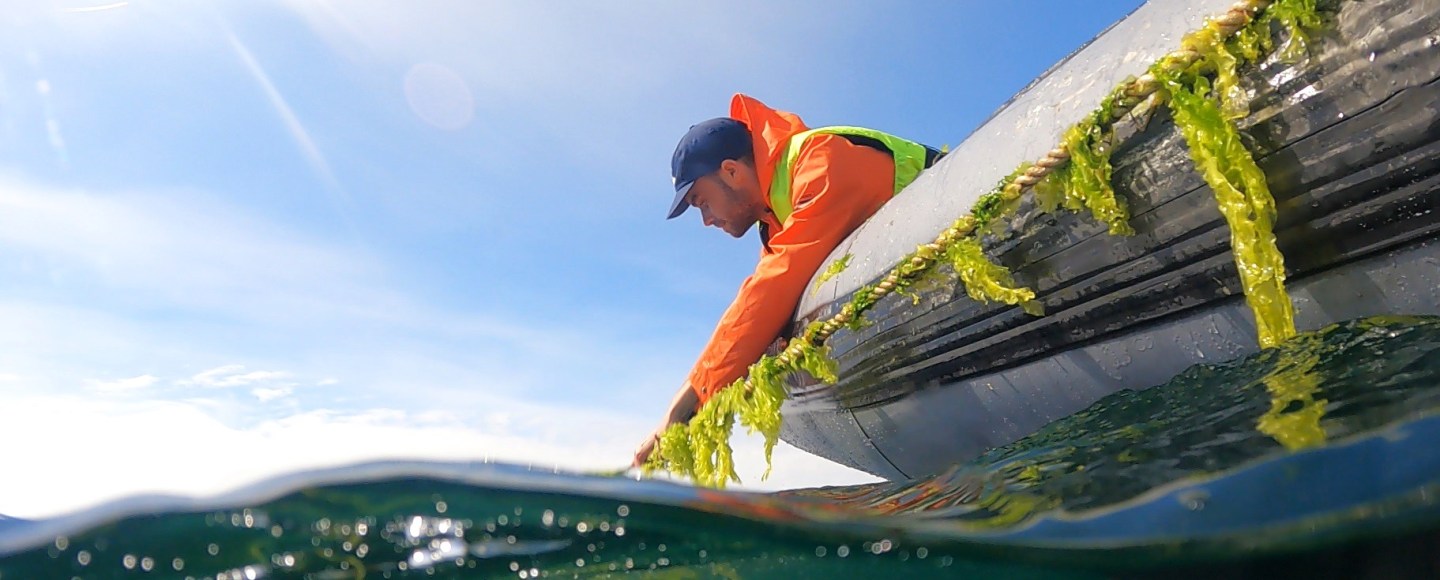
Together with our interdisciplinary team, including partners from University of Gothenburg and Chalmers University of Technology, we are happy to provide a novel method in which we present a way to substantially increase the protein content in the seaweed Ulva. The method using side stream water from the herring food industry is available woth open access in Future Foods.
In short: Our study supports the EU’s Blue Deal “farm to fork” strategy by detailing the value-adding benefits of post-harvest seaweed treatments. It introduces a method to bridge the food-waste gap by integrating food byproducts with seaweed cultivation. Our findings demonstrate that the protein content of U. fenestrata biomass, harvested at its natural protein optimum, can be significantly enhanced through brief post-harvest treatments with herring production process waters. After 14 days in the process water, the crude protein content of U. fenestrata increased by 71.26%, reaching a maximum of 37.37 ± 1.83% dw — the highest recorded in commercially produced Ulva biomass. Additionally, the biomass was free of traceable fish-related allergens and enriched with all essential amino acids in amounts recommended by WHO. This method supports the industrial scalability of protein rich Ulva biomass.

 Sophie Steinhagen - Seaweed Research
Together with our interdisciplinary team, including partners from University of Gothenburg and Chalmers University of Technology, we are happy to provide a novel method in which we present a way to substantially increase the protein content in the seaweed Ulva. The method using side stream water from the herring food industry is available woth open access in Future Foods.
In short: Our study supports the EU’s Blue Deal “farm to fork” strategy by detailing the value-adding benefits of post-harvest seaweed treatments. It introduces a method to bridge the food-waste gap by integrating food byproducts with seaweed cultivation. Our findings demonstrate that the protein content of U. fenestrata biomass, harvested at its natural protein optimum, can be significantly enhanced through brief post-harvest treatments with herring production process waters. After 14 days in the process water, the crude protein content of U. fenestrata increased by 71.26%, reaching a maximum of 37.37 ± 1.83% dw — the highest recorded in commercially produced Ulva biomass. Additionally, the biomass was free of traceable fish-related allergens and enriched with all essential amino acids in amounts recommended by WHO. This method supports the industrial scalability of protein rich Ulva biomass.
Teilen mit: