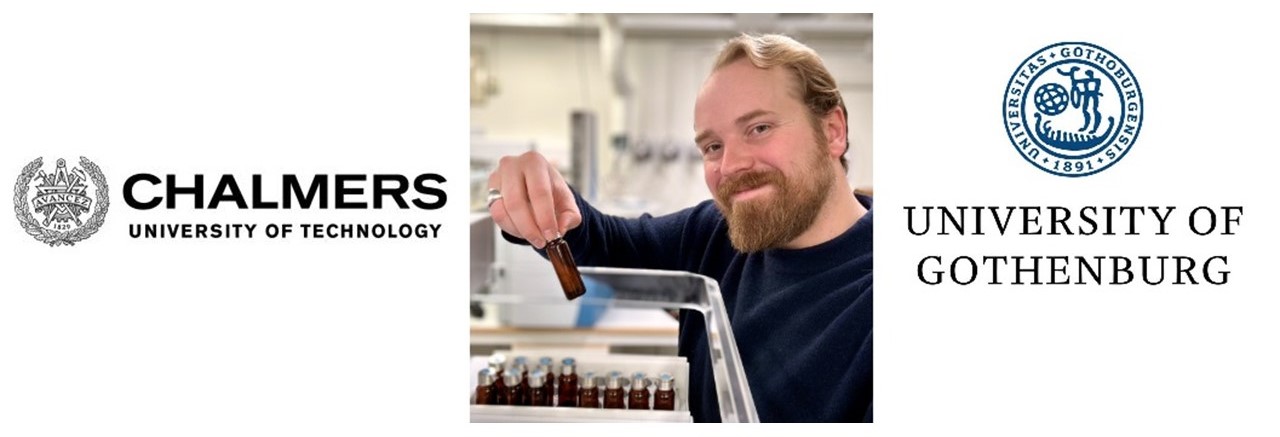
We are pleased to welcome Vincent Marcus to the team as he undertakes his master’s degree project, a collaborative effort between the University of Gothenburg and Chalmers University of Technology. His research focuses on the volatile compounds released during the harvest of sea lettuce, with an emphasis on monitoring and managing sensory properties. Understanding these aspects is essential for ensuring the sustainable development of seaweed in the European market, where odor plays a significant role. As part of his degree project, Vincent is dedicated to addressing this important challenge.
Vincent Marcus: ” A few years ago I was served a meal consisting of halibut wrapped and cooked in copious amounts of algae that would change my outlook on ‘seaweeds’ drastically. Having just graduated with a bachelor’s degree in food sciences and cultures, I understood algae’s potential as a future food source in theory. However, this dish—one of the best I’d ever had— transformed that abstract concept into a tangible experience, sparking my curiosity about algae’s role in modern foodways and its sensory complexities in relation to them. Since then, I’ve made an effort to use seaweed in my meals as often as possible. Sometimes they’re delicious, while at other times, I find that their odor can dominate the dish, making me reluctant to eat it. This challenge is not unique to me as smell plays a critical role in our willingness to consume a food and is an often overlooked factor of consumer acceptance. Adapting the sensorial properties of unfamiliar foods like algae to fit cultural foodways can play a major role in allowing for their integration into diets in which they are not commonly consumed. This, in turn, is a vital step toward reforming food systems and achieving the goals of the Paris Agreement and the United Nations Agenda 2030.
“The fate of a nation depends on the way that they eat.” —Jean Anthelme Brillat-Savarin, 1825.
In my master’s thesis, I have had the opportunity to investigate how the concentration of odor compounds is influenced by harvest practices in Swedish aquaculture of sea lettuce (Ulva fenestrata). Ulva spp. are excellent candidates as future foods, boasting high nutritional content and robust growth potential. However, these algae also have a notable tendency to accumulate high levels of potentially malodorous compounds. By analyzing the volatile headspace of Ulva fenestrata samples exposed to varying degrees of natural stressors, I aim to generate industry-relevant data that links in-field harvesting practices with sensory qualities, ultimately enabling the production of a more controllable and acceptable product. My project is a collaboration between Chalmers University of Technology and Gothenburg University. At Chalmers (Department of Food and Nutrition Science), under the guidance of Ingrid Undeland, I analyze the odorous volatile organic compounds (VOCs) using solid-phase microextraction gas chromatography-mass spectrometry (SPME-GC-MS). The growth and harvesting experiments were conducted at Gothenburg University’s Tjärnö Marine Laboratory, where I had the privilege of working closely with Sophie Steinhagen. This research represents a small but significant step toward integrating sustainable marine foods into new and existing foodways. By understanding and managing the sensory properties of Ulva fenestrata, we can help bridge the gap between innovative food production and cultural acceptance, paving the way for algae to play a vital role in transforming our food systems for a more sustainable and delicious future.”

 Sophie Steinhagen - Seaweed Research
We are pleased to welcome Vincent Marcus to the team as he undertakes his master’s degree project, a collaborative effort between the University of Gothenburg and Chalmers University of Technology. His research focuses on the volatile compounds released during the harvest of sea lettuce, with an emphasis on monitoring and managing sensory properties. Understanding these aspects is essential for ensuring the sustainable development of seaweed in the European market, where odor plays a significant role. As part of his degree project, Vincent is dedicated to addressing this important challenge.
Vincent Marcus: ” A few years ago I was served a meal consisting of halibut wrapped and cooked in copious amounts of algae that would change my outlook on ‘seaweeds’ drastically.
Having just graduated with a bachelor’s degree in food sciences and cultures, I
understood algae’s potential as a future food source in theory. However, this dish—one of the best I’d ever had— transformed that abstract concept into a tangible experience, sparking my curiosity about algae’s role in modern foodways and its sensory complexities in relation to them.
Since then, I’ve made an effort to use seaweed in my meals as often as possible.
Sometimes they’re delicious, while at other times, I find that their odor can dominate the dish, making me reluctant to eat it. This challenge is not unique to me as smell plays a critical role in our willingness to consume a food and is an often overlooked factor of consumer acceptance. Adapting the sensorial properties of unfamiliar foods like algae to fit cultural foodways can play a major role in allowing for their integration into diets in which they are not commonly consumed. This, in turn, is a vital step toward reforming food systems and achieving the goals of the Paris Agreement and the United Nations
Agenda 2030.
“The fate of a nation depends on the way that they eat.”
—Jean Anthelme Brillat-Savarin, 1825.
In my master’s thesis, I have had the opportunity to investigate how the concentration of odor compounds is influenced by harvest practices in Swedish aquaculture of sea lettuce (Ulva fenestrata). Ulva spp. are excellent candidates as future foods, boasting high nutritional content and robust growth potential. However, these algae also have a notable tendency to accumulate high levels of potentially malodorous compounds. By analyzing the volatile headspace of Ulva fenestrata samples exposed to varying degrees of natural stressors, I aim to generate industry-relevant data that links in-field harvesting practices with sensory qualities, ultimately enabling the production of a more controllable and acceptable product. My project is a collaboration between Chalmers University of Technology and Gothenburg University. At Chalmers (Department of Food and Nutrition Science), under the guidance of Ingrid Undeland, I analyze the odorous volatile organic compounds (VOCs) using solid-phase microextraction gas chromatography-mass spectrometry (SPME-GC-MS). The growth and harvesting experiments were conducted at Gothenburg University’s Tjärnö Marine Laboratory, where I had the privilege of working closely with Sophie Steinhagen.
This research represents a small but significant step toward integrating sustainable marine foods into new and existing foodways. By understanding and managing the sensory properties of Ulva fenestrata, we can help bridge the gap between innovative food production and cultural acceptance, paving the way for algae to play a vital role in transforming our food systems for a more sustainable and delicious future.”
Teilen mit: