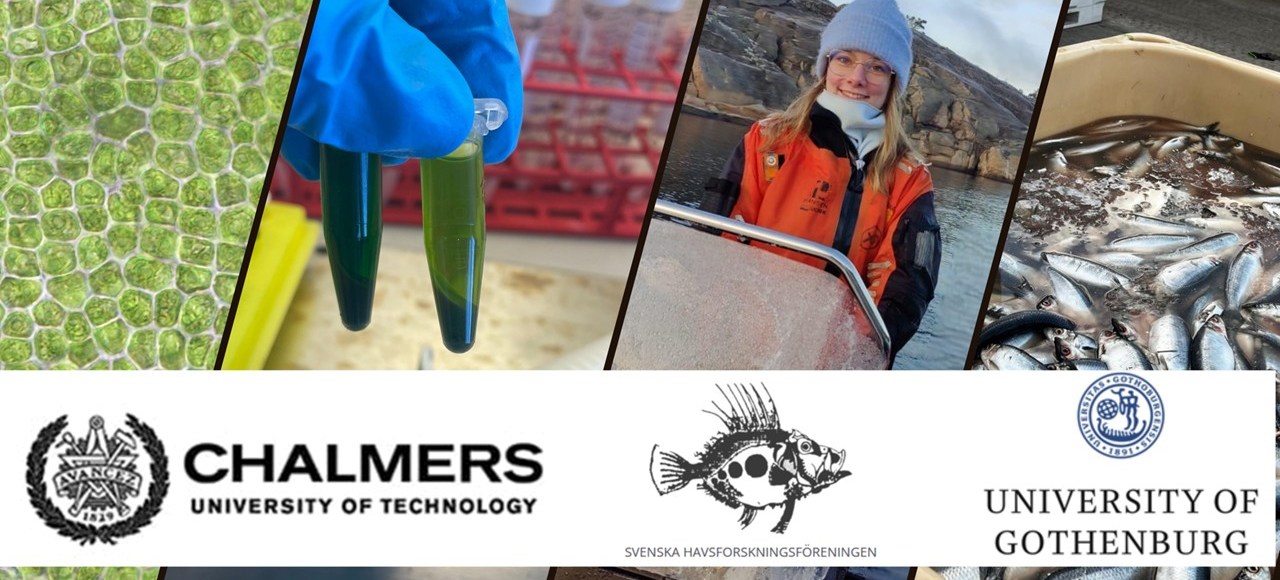
How can we feed a growing world population without exhausting the planet’s land and freshwater resources? For her master’s thesis in Marine Science, Sarah Verhoeven dove into this global challenge — quite literally. Her innovative research on farming green seaweed (Ulva) as a sustainable protein source has now been awarded the prestigious Dyrssen Prize for outstanding student research in marine sciences. The award is instituted by Svenska Havsforskningsföreningen (The Swedish Society for Marine Sciences) in honour of David Dyrssen (1922 – 2011), emeritus professor of analytical chemistry at the University of Gothenburg. As one of the founding members of the Swedish Society for Marine Sciences, he spent his career being an active proponent for the promotion of inter-disciplinary research in marine sciences. The interdisciplinarity was also reflected in Sarah’s thesis, which was conducted as a collaborative project between the Steinhagen lab at the University of Gothenburg and the working group of Ingrid Undeland at Chalmers University of Technology.
Turning Waste into Resource
In her thesis, “EXPLORING THE EFFECTS OF SALINITY AND NUTRIENT INTERACTIONS ON ULVA METABOLIS,” Sarah explored how seaweed can thrive using industrial process water — nutrient-rich byproducts from herring production — instead of conventional fertilizers in different salinity environments. This idea connects two major sustainability goals: reducing waste from the seafood industry and producing climate-friendly, high-protein food. Conducted within a long-standing collaboration between the University of Gothenburg and Chalmers University of Technology, the thesis underscores the impact of interdisciplinary research on closing food waste gaps.
“By cultivating seaweed with recycled nutrients from industry, we can close loops and turn waste streams into valuable resources,” Sarah explains. “It’s about rethinking what we consider ‘waste’ — and seeing it as an opportunity.”
A Tale of Two Seaweeds
Sarah’s experiments focused on two Ulva species common along Sweden’s west coast: Ulva fenestrata and Ulva lacinulata. While they look nearly identical, their reactions to environmental conditions turned out to be quite different.
Both species were grown under varying levels of salinity (5, 15, and 30 PSU) and nutrient sources, including the herring process water. The results were striking:
U. fenestrata showed remarkable tolerance and strong growth even under challenging low-salinity conditions.
U. lacinulata, however, was more sensitive, struggling in low-salinity waters with high ammonium concentrations.
The research revealed that under the right conditions, Ulva can reach protein levels up to 40% of its dry weight, positioning it as a serious contender in the future “green protein” market.
Towards Circular Aquaculture
By showing that seaweed can grow efficiently on process water in low salinities, Sarah’s study provides a model for circular aquaculture systems — where waste from one industry becomes input for another. This concept has the potential to reduce nutrient pollution, lower costs, and expand sustainable food production into marine environments.
Her supervisors, Sophie Steinhagen and Kristoffer Stedt from the Department of Marine Science, highlight the significance of Sarah’s work:
“Sarah’s thesis beautifully bridges fundamental marine biology with applied sustainability. It’s an excellent example of how curiosity-driven science can lead to practical solutions for global challenges.”
An Award-Winning Vision
The Dyrssen Prize, established to recognize outstanding theses in marine sciences, celebrates both academic excellence and societal relevance — two qualities that shine throughout Sarah’s work. Her project reflects the spirit of innovation and collaboration that drives marine research at the University of Gothenburg.
As Sarah puts it, “Seaweed farming is more than just an alternative — it’s a blueprint for how we might live in harmony with the ocean, using its resources wisely to sustain both people and planet.”
With her Dyrssen Prize-winning thesis, Sarah Verhoeven reminds us that the solutions to the future’s biggest challenges might just be growing quietly beneath the waves.
Read more about the project and the prestigious Dyrssen Prize, here.

 Sophie Steinhagen - Seaweed Research
How can we feed a growing world population without exhausting the planet’s land and freshwater resources? For her master’s thesis in Marine Science, Sarah Verhoeven dove into this global challenge — quite literally. Her innovative research on farming green seaweed (Ulva) as a sustainable protein source has now been awarded the prestigious Dyrssen Prize for outstanding student research in marine sciences. The award is instituted by Svenska Havsforskningsföreningen (The Swedish Society for Marine Sciences) in honour of David Dyrssen (1922 – 2011), emeritus professor of analytical chemistry at the University of Gothenburg. As one of the founding members of the Swedish Society for Marine Sciences, he spent his career being an active proponent for the promotion of inter-disciplinary research in marine sciences. The interdisciplinarity was also reflected in Sarah’s thesis, which was conducted as a collaborative project between the Steinhagen lab at the University of Gothenburg and the working group of Ingrid Undeland at Chalmers University of Technology.
Turning Waste into Resource
In her thesis, “EXPLORING THE EFFECTS OF SALINITY AND NUTRIENT INTERACTIONS ON ULVA METABOLIS,” Sarah explored how seaweed can thrive using industrial process water — nutrient-rich byproducts from herring production — instead of conventional fertilizers in different salinity environments. This idea connects two major sustainability goals: reducing waste from the seafood industry and producing climate-friendly, high-protein food. Conducted within a long-standing collaboration between the University of Gothenburg and Chalmers University of Technology, the thesis underscores the impact of interdisciplinary research on closing food waste gaps.
“By cultivating seaweed with recycled nutrients from industry, we can close loops and turn waste streams into valuable resources,” Sarah explains. “It’s about rethinking what we consider ‘waste’ — and seeing it as an opportunity.”
A Tale of Two Seaweeds
Sarah’s experiments focused on two Ulva species common along Sweden’s west coast: Ulva fenestrata and Ulva lacinulata. While they look nearly identical, their reactions to environmental conditions turned out to be quite different.
Both species were grown under varying levels of salinity (5, 15, and 30 PSU) and nutrient sources, including the herring process water. The results were striking:
The research revealed that under the right conditions, Ulva can reach protein levels up to 40% of its dry weight, positioning it as a serious contender in the future “green protein” market.
Towards Circular Aquaculture
By showing that seaweed can grow efficiently on process water in low salinities, Sarah’s study provides a model for circular aquaculture systems — where waste from one industry becomes input for another. This concept has the potential to reduce nutrient pollution, lower costs, and expand sustainable food production into marine environments.
Her supervisors, Sophie Steinhagen and Kristoffer Stedt from the Department of Marine Science, highlight the significance of Sarah’s work:
“Sarah’s thesis beautifully bridges fundamental marine biology with applied sustainability. It’s an excellent example of how curiosity-driven science can lead to practical solutions for global challenges.”
An Award-Winning Vision
The Dyrssen Prize, established to recognize outstanding theses in marine sciences, celebrates both academic excellence and societal relevance — two qualities that shine throughout Sarah’s work. Her project reflects the spirit of innovation and collaboration that drives marine research at the University of Gothenburg.
As Sarah puts it, “Seaweed farming is more than just an alternative — it’s a blueprint for how we might live in harmony with the ocean, using its resources wisely to sustain both people and planet.”
With her Dyrssen Prize-winning thesis, Sarah Verhoeven reminds us that the solutions to the future’s biggest challenges might just be growing quietly beneath the waves.
Read more about the project and the prestigious Dyrssen Prize, here.
Teilen mit: