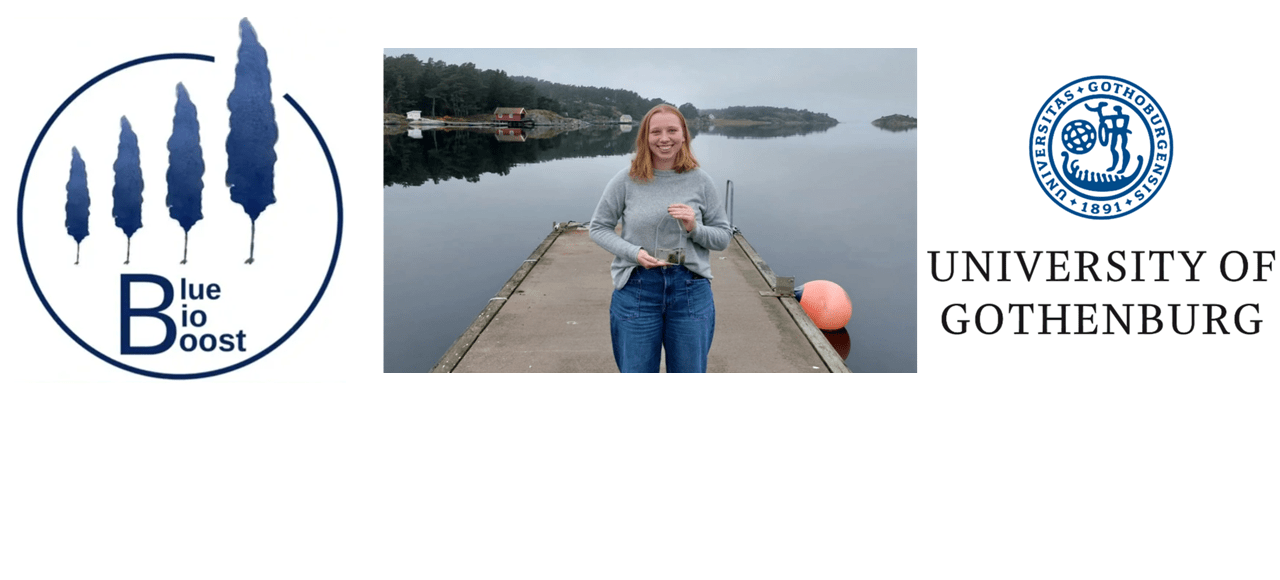
We are happy to welcome Inga Hellige to the seaweed research group at the University of Gothenburg. As a postdoctoral researcher, Inga will be working on advancing sustainable aquaculture and strain selection of sea lettuce.
Inga Hellige: “I am currently working with Ulva, a green seaweed also known as sea lettuce, which holds great potential as a future crop for sustainable aquaculture. My research is part of the EU-funded BlueBioBoost Project, which aims to develop and advance breeding strategies for seaweeds to support a sustainable expansion of aquaculture in Europe.
In my work, I investigate how genetic variation and different levels of polyploidy shape the morphology, growth potential, and stability of Ulva species. My research focuses particularly on fast-growing “giant” individuals. I am examining whether their giant traits can be inherited, grown large-scale and what their biochemical profiles might offer for future applications. Through this, I aim to identify genetic and physiological factors that could support future applications in aquaculture, biotechnology and environmental sustainability.
During my PhD, I investigated the role of brown macroalgae in carbon sequestration, with a particular focus on the fate of dissolved organic carbon and its associated sugars. The carbon storage through macroalgae is most effective when paired with large-scale aquaculture and reforestation efforts.
I have always been interested in the cultivation of macroalgae for both the aquaculture industry and for ecosystem restoration. Being able to focus now on their cultivation and growth is particularly exciting. I am motivated by the opportunity to help improve Ulva aquaculture and contribute to a sustainable food production in Europe.”

 Sophie Steinhagen - Seaweed Research
We are happy to welcome Inga Hellige to the seaweed research group at the University of Gothenburg. As a postdoctoral researcher, Inga will be working on advancing sustainable aquaculture and strain selection of sea lettuce.
Inga Hellige: “I am currently working with Ulva, a green seaweed also known as sea lettuce, which holds great potential as a future crop for sustainable aquaculture. My research is part of the EU-funded BlueBioBoost Project, which aims to develop and advance breeding strategies for seaweeds to support a sustainable expansion of aquaculture in Europe.
In my work, I investigate how genetic variation and different levels of polyploidy shape the morphology, growth potential, and stability of Ulva species. My research focuses particularly on fast-growing “giant” individuals. I am examining whether their giant traits can be inherited, grown large-scale and what their biochemical profiles might offer for future applications. Through this, I aim to identify genetic and physiological factors that could support future applications in aquaculture, biotechnology and environmental sustainability.
During my PhD, I investigated the role of brown macroalgae in carbon sequestration, with a particular focus on the fate of dissolved organic carbon and its associated sugars. The carbon storage through macroalgae is most effective when paired with large-scale aquaculture and reforestation efforts.
I have always been interested in the cultivation of macroalgae for both the aquaculture industry and for ecosystem restoration. Being able to focus now on their cultivation and growth is particularly exciting. I am motivated by the opportunity to help improve Ulva aquaculture and contribute to a sustainable food production in Europe.”
Teilen mit: