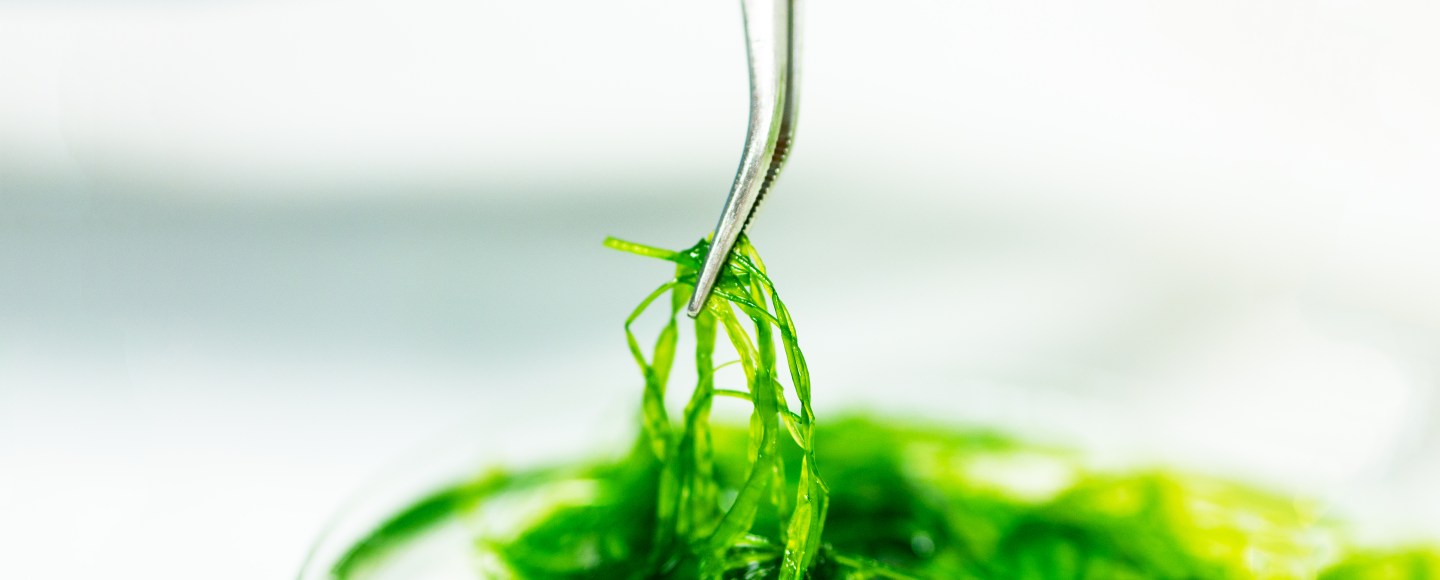
As a seaweed taxonomist and ecologist my main research focus lies on the investigation of marine macroalgae biodiversity, their genetic and species diversity, as well as on the various ways we can use macroalgae as sustainable and eco-friendly future resources and their physiological properties. Combining my research in interdisciplinary projects helps me to reach my professional goals: protect and maintain biodiversity, contribute to a good ocean health status, and explore new scientific ways to contribute to the green future of mankind. Therefore, interdisciplinary solution approaches together with international research partners are carried out to answer scientific questions on single species, community, or ecosystem level.
Ongoing research projects:
- GreenTaxa – Biodiversity, taxonomy, and systematics of the marine green macroalgae class Ulvophyceae in Sweden: Funded by The Swedish Taxonomy Initiative, Artdatabanken (3.5 Million SEK; runtime 2026-2028). This project aims to deliver the first systematic assessment of the marine green macroalgae biodiversity, distribution, and habitat use of the class Ulvophyceae in Sweden—an ecologically and economically important but largely overlooked group. By combining classical morphological analysis, ontogenetic studies, and advanced molecular techniques (DNA barcoding & high-throughput full-chloroplast sequencing) with cutting-edge model-based species delimitation we will shed light on this widely under-researched group of green algae.
- An Ocean of Unknown Species – Unravelling the biodiversity of Norway´s key ecologically and economically important green macroalgae: Funded by The Norwegian Taxonomy Initiative, Artsdatabanken (4 Million NOK; runtime 2026-2029). This project represents the first comprehensive assessment of the biodiversity, biogeography, and habitat utilization of marine green macroalgae (Ulvophyceae) in Norway—an ecologically and economically pivotal yet underexplored algal group. Integrating classical morphological taxonomy, ontogenetic characterization, and advanced molecular methodologies—including DNA barcoding, high-throughput sequencing, phylogenomic reconstruction, and model-based species delimitation—the study aims to resolve long-standing taxonomic ambiguities and uncover cryptic diversity. By re-examining historical herbarium vouchers in conjunction with newly collected specimens, the project will establish a robust temporal and spatial framework for Norwegian Ulvophyceae diversity. This framework will elucidate shifts in species composition and distribution, provide a baseline for monitoring ecological and climatic change, and enhance understanding of macroalgal roles in ecosystem productivity, eutrophication events, and the emerging Scandinavian Blue Economy
- Joint Nordic Seaweed Innovation Network – JNSIN: Funded by The Nordic Council of Ministers (300 000 DK; runtime 2024-2025). There are still knowledge gaps in the production of Ulva spp., and further research is needed to optimize and streamline the entire value chain.This project aims to bring together scientific expertise from research institutions and industry across the Nordic countries to identify these knowledge gaps and production bottlenecks. The goal is to develop innovative technical solutions, explore economic opportunities, and define key areas for future collaboration. The results of the project are expected to significantly improve the efficiency and sustainability of Ulva production both on land and at sea, helping to strengthen the economic viability of its value chain and support a sustainable Blue Economy in the Nordic region.
- BlueBioBoost – (Boosting seaweed farming through better utilization of genetic resources): Funded by the EU Sustainable Blue Economy Partnership (grant number: SBEP2023-476; 1.4 Million €; runtime 2024-2027). Macroalgal biomass has multiple uses and is recognized as a target for increased production in Europe. In order to boost the growing seaweed industry, it is necessary to better utilise the genetic variation to increase yield, quality and stability of the cultivated crop, which is the main aim of the BlueBioBoost (BBB) project. BBB will develop a novel macroalgal breeding program involving monitoring of profound genetic changes and applying methods of preventing cultivated macroalgae from hybridizing with natural populations to keep our precious marine ecosystems healthy while simultaneously laying a basis for the European Blue Economy to sustainably better use genetic resources.
- MacroSea-MicroB – (Seaweed microbiome resources for a growing blue economy): Funded by the European Marine Biological Resource Centre, EMBRC (grant number: JDA ID 3003; 100 000 €; runtime 2024-2026). Providing defined microbiome samples is well-established in human health and animal research but such services do not yet exist for seaweed or other environmental applications. MacroSea-MicroB will establish protocols to biobank seaweed-associated microbiomes, which are key to addressing fundamental biological questions and are increasingly valued in aquaculture and restoration efforts. The project will assess the feasibility of preserving seaweed strains along with their associated microbiome and integrate these resources into the EMBRC-TRACE database so researchers can access them easily for lab experiments.
- ULTFARMS – (circUlar Low Trophic oFfshore Aquaculture in wind farms and Restoration of Marine Space): Funded by HORIZON EUROPE (grant number: 101093888; 10.3 Million €; runtime 2023-2026). The EU-funded ULTFARMS project aims to move beyond the current low trophic aquaculture (LTA) systems with novel engineering, technical, ecological and biological processes to improve production potential in harsh offshore conditions and/or low-salinities while supporting LTA integration with offshore wind farms (OWFs). The project will engage research and industry in co-developing and co-managing novel designs and operations in six LTA pilots in OWF locations across the North and Baltic Seas. The ambition is to advance LTA in offshore hostile environments while safeguarding the environment, minimising carbon footprint and addressing commercial viability. Finally, ULTFARMS will aim towards the replicability and transferability of the newly acquired knowledge.
- A manual for the use of sustainable marine resources – (Definition of the cultivation potential and commercially relevant compounds of Sea Lettuces (Ulva spp.) along the Swedish coastline): Funded by the Swedish Research Council FORMAS (grant number: 2022-00331; 4 Million SEK; runtime 2023-2026). Even though, sea lettuces (Ulva) are obtaining a rising interest from the European aquaculture sector, knowledge of their taxonomy, species diversity and thus species depending properties is still sparse. Their high morphological variability largely hampers species identification by classical morphological characters. In this project I propose to assess the species diversity by modern molecular methods within the Baltic Sea, and to investigate species depending traits and how differences in high value compounds vary under changing cultivation conditions to facilitate strain selection of highly productive aquaculture strains. All results will be communicated with authorities, databases and commercial partners to ensure a strong societal impact of this research which can clearly contribute to a more sustainable future blue economy.
Ongoing collaborative research projects:
- Unveilling the rich hidden diversity of microfilamentous marine green algae (Chlorophyta) in Norway: Funded by The Norwegian Taxonomy Initiative (Artsdatabanken) – (5.6 Million NOK; runtime 2024-2027; Main coordinator: NMBU Norwegian University of Life Sciences). Marine green algae, particularly microfilamentous varieties, are understudied in Norway despite their prevalence in marine ecosystems. Their taxonomic classification is challenging due to their small size and the lack of distinct morphological features, compounded by the presence of cryptic diversity. This neglect has led to a significant gap in understanding their taxonomy and distribution, both nationally and globally. Preliminary research has identified new species and expanded the known distribution of others in Norwegian waters. These algae play diverse ecological roles, from mutualistic to parasitic, impacting host dynamics and influencing economically important macroalgal species. Our forthcoming research project aims to inventory marine green algae across various habitats along the Norwegian coast, employing molecular techniques to elucidate species diversity and establish a DNA barcode library for future studies. As well as to unravel evolutionary phenomena within these fascinating and ecologically relevant organisms.
- BlueGreen: Funded by the Swedish Research Council FORMAS (grant number: 2021-02340; 8 Million SEK; runtime 2021-2025; Main coordinator Chalmers University of Technology): This project recognizes the great potential of the fast-growing seaweed species Ulva fenestrata as a new ecologically cultivated Swedish protein crop. As other seaweeds, Ulva contains important micronutrients as vitamin B12 and LC n-3 PUFA, and its production do not compete for arable land nor require fertilizers, pesticides, and freshwater irrigation. On the contrary, seaweed can remediate nutrient-rich waters. BLUEGREEN proposes a well-planned combination of sea-based (non-fertilized) and short-term, post-harvest tank cultivation of Ulva. In the latter step, nutrient-rich, but currently wasted, process waters from the seafood industry are used as organic fertilizers to elevate protein levels. In this way, Ulva could form a new circular production system for a protein-rich biomass.
- CirkAlg: Macroalgae as carriers of nutrients in a circular food chain – innovative steps towards a protein shift. Funded by the Swedish Research Council FORMAS (grant number: 2018-01839; 7.5 Million SEK; runtime: 2019-2023; Main coordinator Chalmers University of Technology). The project is a collaboration between several Universities, companies and a government agency with the aim to develop techniques to increase the protein amount in seaweed in two steps and in ingredients made from these. In a first step the seaweed is cultivated in nutrient rich media and in a second step scalable processes will be developed to concentrate the protein from the cultivated seaweed. Other central objectives of the project include analysis of tastiness, nutrition value and food safety of the developed protein ingredients and in products containing these.
Dr. Sophie Steinhagen
 Sophie Steinhagen - Seaweed Research