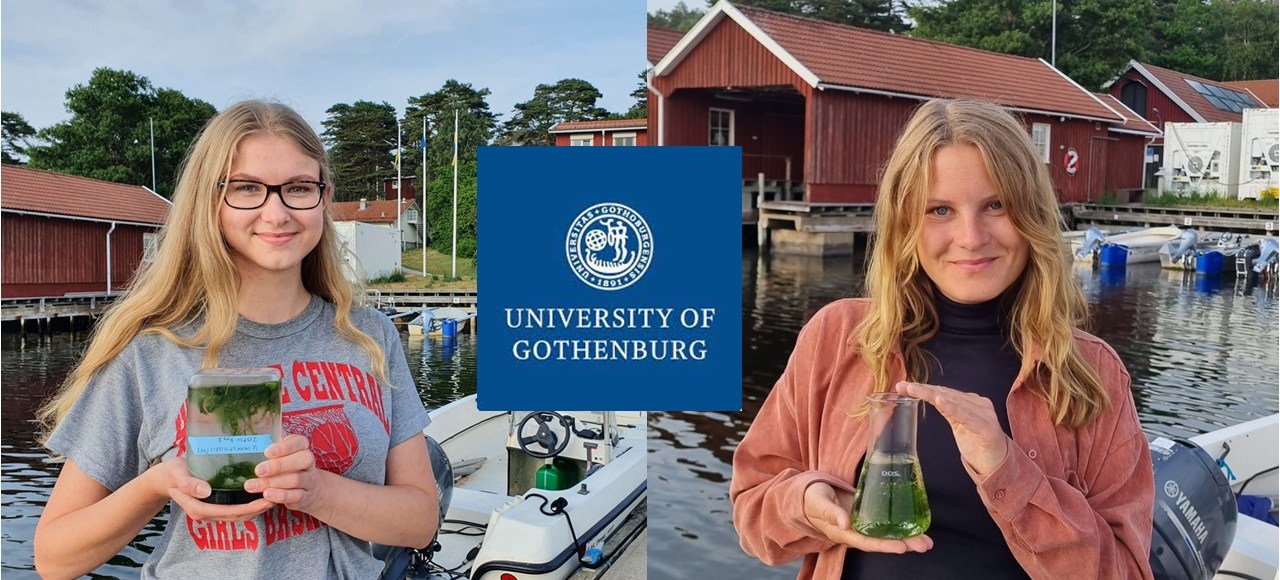
We are happy to welcome Louise Kramár and Ida Johansson to the seaweed research group at the University of Gothenburg. During their degree projects the young seaweed researchers will cover the important and interesting fields of Ulva taxonomy and focus on a sustainable seaweed aquaculture in the Baltic Sea. Read about the ongoing projects of Louise and Ida and how they aim to contribute to healthy marine ecosystems:
Louise Kramár: “In my first year as a bachelor’s student, I was shown the large cultivation tanks with neon green Ulva floating around. I was fascinated and a lot of questions came to be asked. What can we use it for? How is it cultivated? How common is it in Swedish waters? It turned out that this seaweed has a lot of potential in various areas, though possesses a rather mysterious behaviour. Within the genus Ulva, different species can look almost identical – even on an microscopical level – or the same species can have individuals that vary in cell-shapes, branching pattern, length or thickness, just to mention a few criteria. This is something I have witnessed myself during both my bachelor’s thesis and in my ongoing master’s thesis by studying the morphology of Ulva spp..
Louise Kramár collects fresh Ulva material for ontogentic and morphological observations
Throughout history, identification keys and descriptions of Ulva species have consisted of morphological characters such as anything from how it grows in different habitats to how the chloroplasts in the cells are oriented. However, through DNA-barcoding I have been able to see that the evolutionary relationship on a molecular level do not necessarily overlap with morphological traits. During my thesis I will constitute detailed descriptions of eight unidentified species that have been collected along the Atlantic-Baltic Sea transect. By sequencing preserved material and freshly collected specimens, I can illustrate phylogenetic relationships with existing reference sequences. This will, for example, present genetically distinct species or variations of subspecies. Altogether, I will do morphological observations and molecular analyses of all eight species and study the life cycle on cultivated entities from new collections. Combining these three methods while comparing my data to previous data and reference material, I am hoping to determine if these Ulva entities resembles cryptic or newly introduced species. This is an exciting project, as it elaborates further on the morphological and phenotypical plasticity in Ulva, something that can assist in separating species and ecotypes. As a result, this study will contribute to reference data, type material and developed descriptions of Ulva spp.. As for future purposes it will clarify the Ulva diversity, facilitate monitoring of ecosystems, invasive species or simplify evaluation for commercial cultivation.”
Ida Johansson: “In my master thesis I am investigating the potential of off-shore cultivation of various species of Ulva in the southern Baltic Sea. This project is being done within the EU funded ULTFARMS project, which aims to combine low trophic aquaculture systems with off-shore windfarms. With my project an opportunity for cultivation of Ulva in a previously unused area for seaweed cultivation, the Baltic Sea, is evaluated. This is of importance as the growing population creates an increasing demand for novel spaces to provide sustainable resources, which this project aims to do. To investigate the cultivation potential, I am currently preforming salinity tolerance experiments with five different species of Ulva, namely U. fenestrata, U. compressa, U. lacinulata, U. intestinalis and U. linza. In addition to comparing species, I will also be able to compare different strains of the same specie as collection of U. intestinalis has been done in different locations and salinity regimes, which will allow us to see if there could be differences in response to different salinities within a specie. The cultivation potential of these species will be estimated based on how the composition of biomass and reproduction is affected by different salinities. Subsequently, I will analyze the samples for carbohydrate, protein, pigment and phenolic contents. In addition, growth rate and development of fertile biomass will be measured. Ulva has been observed to differ in nutrients when existing in different environments and as such it is important to analyze the composition of biochemical compounds, to see if there is an increase or loss of valuable compounds at different farm grounds. For example, protein content in Ulva can be affected by various factors. As green proteins are becoming an increasingly attractive protein source it is of importance to investigate if the protein content changes with changing ecosystems.
Ida Johansson conducting performance measurements on different Ulva isolates to assess their application in aquaculture
This is a very exciting project to be a part of, as I am interested in seaweed cultivation as well as contributing to a sustainable future. I am eager to get the results of my study and thereafter hopefully be able to suggest an optimal species of Ulva for cultivation in the Baltic Sea!”

 Sophie Steinhagen - Seaweed Research
We are happy to welcome Louise Kramár and Ida Johansson to the seaweed research group at the University of Gothenburg. During their degree projects the young seaweed researchers will cover the important and interesting fields of Ulva taxonomy and focus on a sustainable seaweed aquaculture in the Baltic Sea. Read about the ongoing projects of Louise and Ida and how they aim to contribute to healthy marine ecosystems:
Louise Kramár: “In my first year as a bachelor’s student, I was shown the large cultivation tanks with neon green Ulva floating around. I was fascinated and a lot of questions came to be asked. What can we use it for? How is it cultivated? How common is it in Swedish waters? It turned out that this seaweed has a lot of potential in various areas, though possesses a rather mysterious behaviour. Within the genus Ulva, different species can look almost identical – even on an microscopical level – or the same species can have individuals that vary in cell-shapes, branching pattern, length or thickness, just to mention a few criteria. This is something I have witnessed myself during both my bachelor’s thesis and in my ongoing master’s thesis by studying the morphology of Ulva spp..
Throughout history, identification keys and descriptions of Ulva species have consisted of morphological characters such as anything from how it grows in different habitats to how the chloroplasts in the cells are oriented. However, through DNA-barcoding I have been able to see that the evolutionary relationship on a molecular level do not necessarily overlap with morphological traits. During my thesis I will constitute detailed descriptions of eight unidentified species that have been collected along the Atlantic-Baltic Sea transect. By sequencing preserved material and freshly collected specimens, I can illustrate phylogenetic relationships with existing reference sequences. This will, for example, present genetically distinct species or variations of subspecies. Altogether, I will do morphological observations and molecular analyses of all eight species and study the life cycle on cultivated entities from new collections. Combining these three methods while comparing my data to previous data and reference material, I am hoping to determine if these Ulva entities resembles cryptic or newly introduced species. This is an exciting project, as it elaborates further on the morphological and phenotypical plasticity in Ulva, something that can assist in separating species and ecotypes. As a result, this study will contribute to reference data, type material and developed descriptions of Ulva spp.. As for future purposes it will clarify the Ulva diversity, facilitate monitoring of ecosystems, invasive species or simplify evaluation for commercial cultivation.”
Ida Johansson: “In my master thesis I am investigating the potential of off-shore cultivation of various species of Ulva in the southern Baltic Sea. This project is being done within the EU funded ULTFARMS project, which aims to combine low trophic aquaculture systems with off-shore windfarms. With my project an opportunity for cultivation of Ulva in a previously unused area for seaweed cultivation, the Baltic Sea, is evaluated. This is of importance as the growing population creates an increasing demand for novel spaces to provide sustainable resources, which this project aims to do. To investigate the cultivation potential, I am currently preforming salinity tolerance experiments with five different species of Ulva, namely U. fenestrata, U. compressa, U. lacinulata, U. intestinalis and U. linza. In addition to comparing species, I will also be able to compare different strains of the same specie as collection of U. intestinalis has been done in different locations and salinity regimes, which will allow us to see if there could be differences in response to different salinities within a specie. The cultivation potential of these species will be estimated based on how the composition of biomass and reproduction is affected by different salinities. Subsequently, I will analyze the samples for carbohydrate, protein, pigment and phenolic contents. In addition, growth rate and development of fertile biomass will be measured. Ulva has been observed to differ in nutrients when existing in different environments and as such it is important to analyze the composition of biochemical compounds, to see if there is an increase or loss of valuable compounds at different farm grounds. For example, protein content in Ulva can be affected by various factors. As green proteins are becoming an increasingly attractive protein source it is of importance to investigate if the protein content changes with changing ecosystems.
This is a very exciting project to be a part of, as I am interested in seaweed cultivation as well as contributing to a sustainable future. I am eager to get the results of my study and thereafter hopefully be able to suggest an optimal species of Ulva for cultivation in the Baltic Sea!”
Teilen mit: