We extend a warm welcome to Elena Schrofner-Brunner as the newest addition to the seaweed research group at the University of Gothenburg. In the course of her Erasmus+ project, Elena will delve into the crucial realms of establishing sustainable seaweed aquaculture practices in the Baltic Sea. Explore the ongoing initiatives of Elena, and discover her endeavors to bolster the well-being of marine ecosystems:
Elena Schrofner-Brunner: “Seaweeds and I seem to always find a way back to one another. I have always been intrigued by their plasticity, their ability to not only endure all kinds of different and often harsh environments, but to thrive in them. They are not only habitat formers and a food source for various species, but also carry the potential to be of high value for mankind as a sustainable resource for different sectors, including food production.
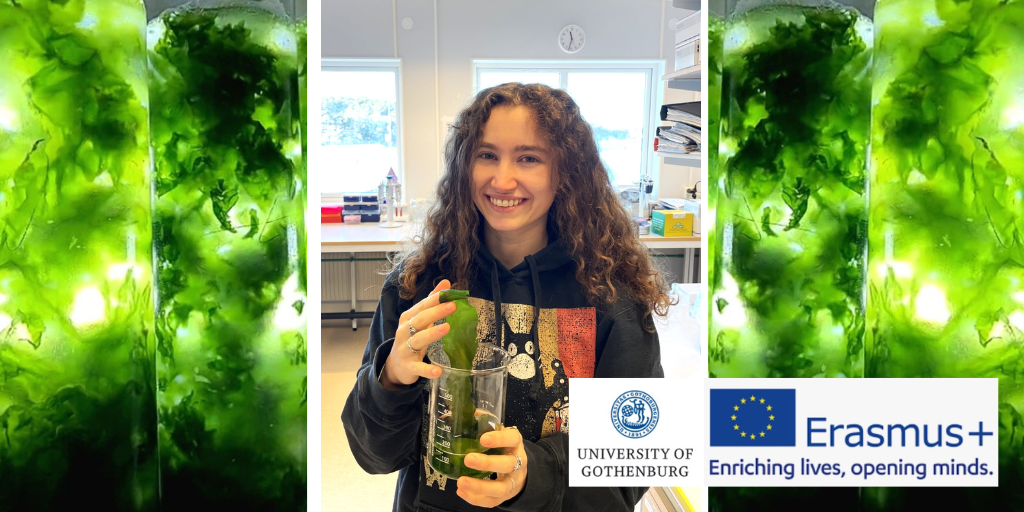
Erasmus+ scholar, Elena Schrofner-Brunner, extracts high-value biochemicals from seaweed biomass at the lab of the Tjärnö Marine laboratory, University of Gothenburg
During my master’s thesis, I was allowed a first insight into seaweed research, working on nutrient limitation during seaweed blooms, especially in green algae. I decided to pursue an EU funded Erasmus+ internship on seaweeds and delve deeper into the topics of cultivation and identification.
While working with Sophie, I am, among other things, looking at the correlation between valuable compounds, for instance proteins, in various species of Ulva and environmental variables like salinity, dissolved nutrients or temperature. This project will contribute to the knowledge base on how to cultivate and identify Ulva, as well as to the Farm to Fork strategy of the EU, which aims for more environmentally-friendly food sources.
The nitrogen content in seaweed tissue can be used as a measure of seaweed protein content, which, given the increasing interest in using seaweeds as an alternative protein source in the food sector, further provides substantial information concerning a species’ potential role as such. In previous studies, protein content was found to depend on the nutrient availability in the seaweed’s surrounding waters and their salinity, meaning the protein content within the algal biomass can change drastically, when for instance cultivated in the Skagerrak or Baltic Sea, where nutrient influxes and salinity regimes can differ widely.
I have always been eager to focus on finding paths leading towards a more sustainable future. Hence, gaining a broader understanding of the mechanisms underlying algal growth and their ways of coping with fluctuations in said environmental variables will certainly bring us one step closer to developing sustainable aquaculture techniques.
I am excited to be allowed to contribute to taking that step and to help finding optimised strategies in the cultivation of Ulva for food production in my Erasmus+ internship!”

 Sophie Steinhagen - Seaweed Research
We extend a warm welcome to Elena Schrofner-Brunner as the newest addition to the seaweed research group at the University of Gothenburg. In the course of her Erasmus+ project, Elena will delve into the crucial realms of establishing sustainable seaweed aquaculture practices in the Baltic Sea. Explore the ongoing initiatives of Elena, and discover her endeavors to bolster the well-being of marine ecosystems:
Elena Schrofner-Brunner: “Seaweeds and I seem to always find a way back to one another. I have always been intrigued by their plasticity, their ability to not only endure all kinds of different and often harsh environments, but to thrive in them. They are not only habitat formers and a food source for various species, but also carry the potential to be of high value for mankind as a sustainable resource for different sectors, including food production.
During my master’s thesis, I was allowed a first insight into seaweed research, working on nutrient limitation during seaweed blooms, especially in green algae. I decided to pursue an EU funded Erasmus+ internship on seaweeds and delve deeper into the topics of cultivation and identification.
While working with Sophie, I am, among other things, looking at the correlation between valuable compounds, for instance proteins, in various species of Ulva and environmental variables like salinity, dissolved nutrients or temperature. This project will contribute to the knowledge base on how to cultivate and identify Ulva, as well as to the Farm to Fork strategy of the EU, which aims for more environmentally-friendly food sources.
The nitrogen content in seaweed tissue can be used as a measure of seaweed protein content, which, given the increasing interest in using seaweeds as an alternative protein source in the food sector, further provides substantial information concerning a species’ potential role as such. In previous studies, protein content was found to depend on the nutrient availability in the seaweed’s surrounding waters and their salinity, meaning the protein content within the algal biomass can change drastically, when for instance cultivated in the Skagerrak or Baltic Sea, where nutrient influxes and salinity regimes can differ widely.
I have always been eager to focus on finding paths leading towards a more sustainable future. Hence, gaining a broader understanding of the mechanisms underlying algal growth and their ways of coping with fluctuations in said environmental variables will certainly bring us one step closer to developing sustainable aquaculture techniques.
I am excited to be allowed to contribute to taking that step and to help finding optimised strategies in the cultivation of Ulva for food production in my Erasmus+ internship!”
Teilen mit: